From Zero Online Presence to a ₹20 Lakh Project in 4 Weeks
Client: Design Intend — Architecture & Interior Design Studio, Hosur
Ar. Chittrarasan runs one of the most skilled architecture and design studios in Hosur. He had a decade of completed projects, happy clients, and word-of-mouth referrals — and absolutely zero presence online. No website. No Google listing. Nothing. Here is what happened when we fixed that.
Project at a glance
| Client | Design Intend, Hosur, Tamil Nadu |
| Industry | Architecture & interior design |
| Starting point | No website, no GBP, no social channels |
| What we delivered | Authority website, Google Business Profile, Instagram & Facebook setup |
| Investment | ₹40,000 one-time (website) + ₹35,000/month (local SEO + social + optimisation) |
| Timeline to first lead | 4 weeks from launch |
| First conversion | Office interior project worth ₹20 lakh |
| Live website | designintend.com |
In this case study
Where Design Intend started
When Ar. Chittrarasan first came to us, the situation was pretty common among skilled professionals in Hosur and the surrounding belt: excellent at the work, almost invisible online.
Design Intend had completed farm houses in Kerala, villas in Hosur, office interiors, residential projects in Bengaluru. The portfolio was genuinely impressive. But when someone in Hosur searched "architect near me" or "interior designer Hosur" on Google, Design Intend simply did not exist. No website, no Google Business Profile, no Instagram page with project photos — nothing that a prospective client could find.
Referrals were keeping work coming in, but referrals have a ceiling. They depend entirely on who the previous client knows, whether they remember to mention you at the right moment, and whether the timing lines up. A single good project showing up in search results can generate enquiries indefinitely, at any hour, from clients who were never in anyone's network.
The gap between what Design Intend had built and what the outside world knew about them was the opportunity.
What the opportunity actually looked like
Before writing a single line of code, we spent time understanding the competitive landscape. What does someone searching for an architect or interior designer in Hosur actually see on Google right now?
The answer, honestly, was thin. There are a handful of architecture firms and interior studios in Hosur and the immediate surrounding areas — Bagalur, Attibele, Denkanikottai, Sarjapura — but most of them had weak or outdated websites, thin content, and inconsistent Google Business Profiles. A few were listed on JustDial but not much else.
This is the pattern we see across smaller Indian cities: the market has real, commercial search volume, but the businesses haven't claimed it yet. Hosur in particular is growing fast, with industrial expansion and residential development bringing a new wave of homeowners and office developers who search online before picking a professional.
The keyword set we mapped out covered the expected terms — "architect Hosur", "interior designer Hosur", "house construction Hosur" — but also the specific queries that signal someone is close to hiring: "turnkey construction Hosur", "villa builders Hosur", "modular kitchen Hosur". These are buyer-intent searches, not exploratory ones. Someone typing "turnkey construction Hosur" has already made the mental shift from "I'm curious" to "I want to find someone."
For a brand-new website with no history, going after the highest-volume generic terms first would take too long. The faster path was to target the specific, commercial-intent queries where competition was genuinely low. Win those first, build domain authority, then move up.
What we built and why
The brief was to build something that would do the work of a business development team — available 24 hours, answering the right questions, building trust before the first phone call.
The website
We built designintend.com as an authority site, not a brochure. There is a difference. A brochure site says "here is what we do." An authority site says "here is what we know, here is who we've helped, and here is why you should trust us with something as significant as your home or office."
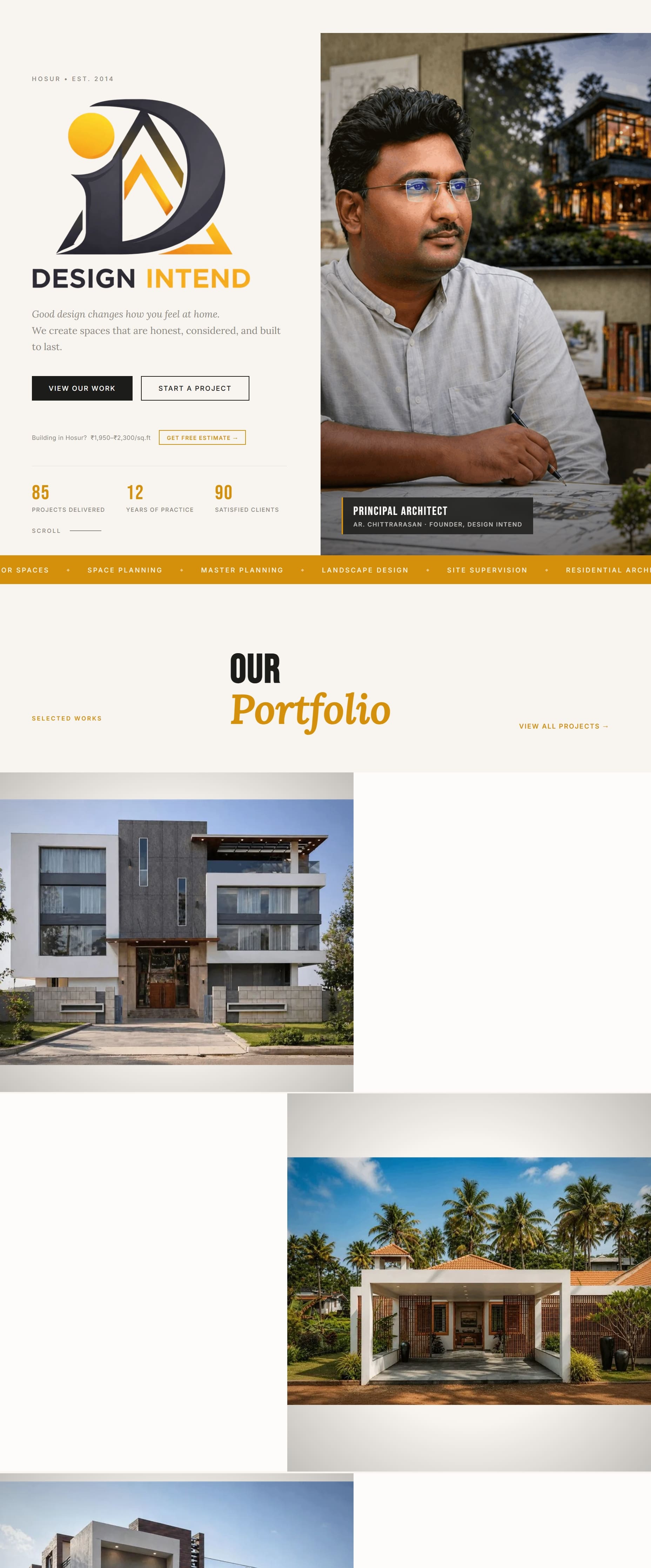
The architecture covered:
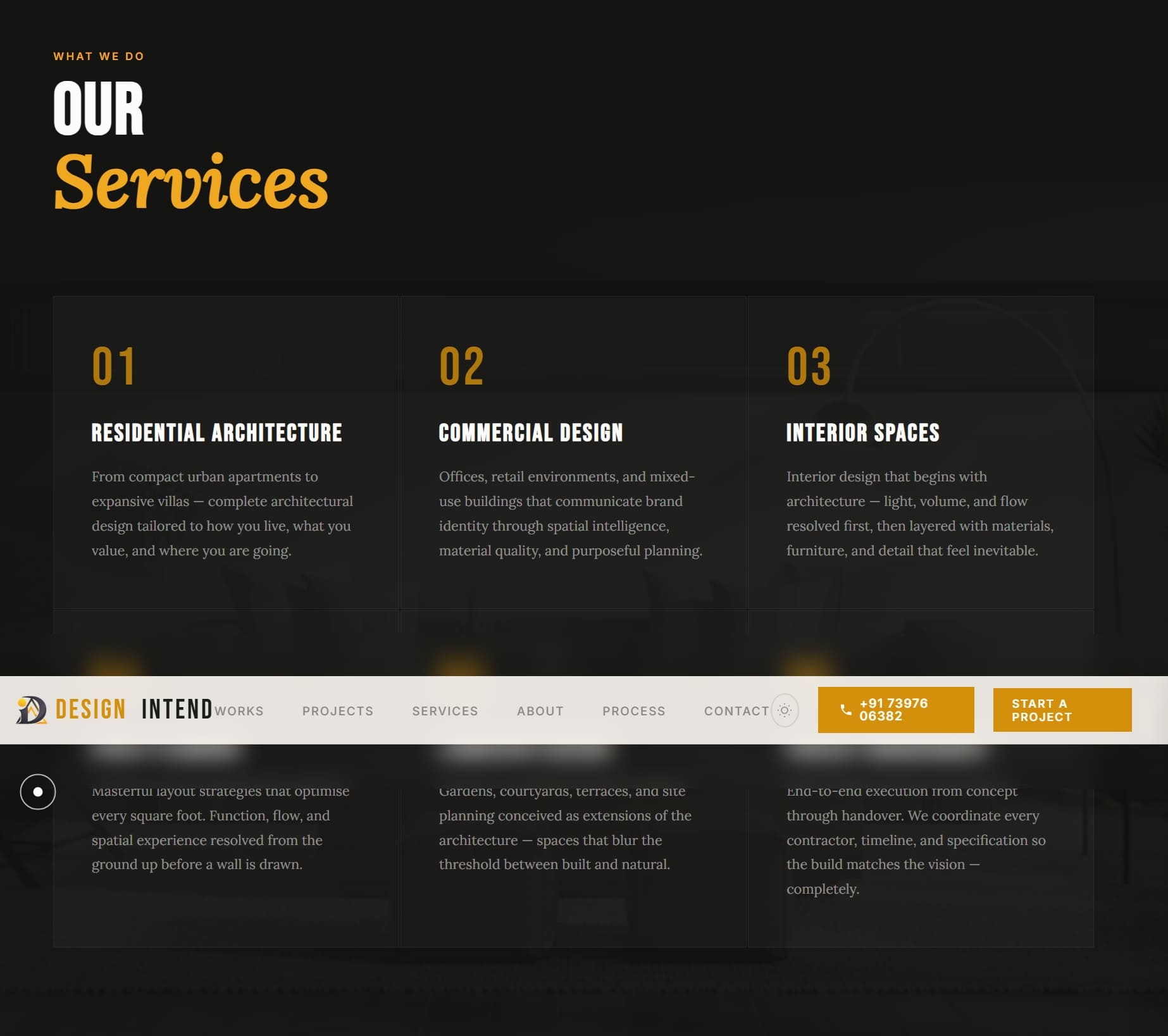
- Service pages for every relevant category — residential architecture, interior design, construction, turnkey services — each written to answer the questions a prospective client actually has, not just describe services in abstract terms.
- Location-specific pages for Hosur, Bagalur, Denkanikottai, Attibele, and Sarjapura. Not keyword-stuffed copies of each other. Each one addresses the specific context of that area: what kind of plots are common there, what construction constraints people face, what design styles work in the local climate.
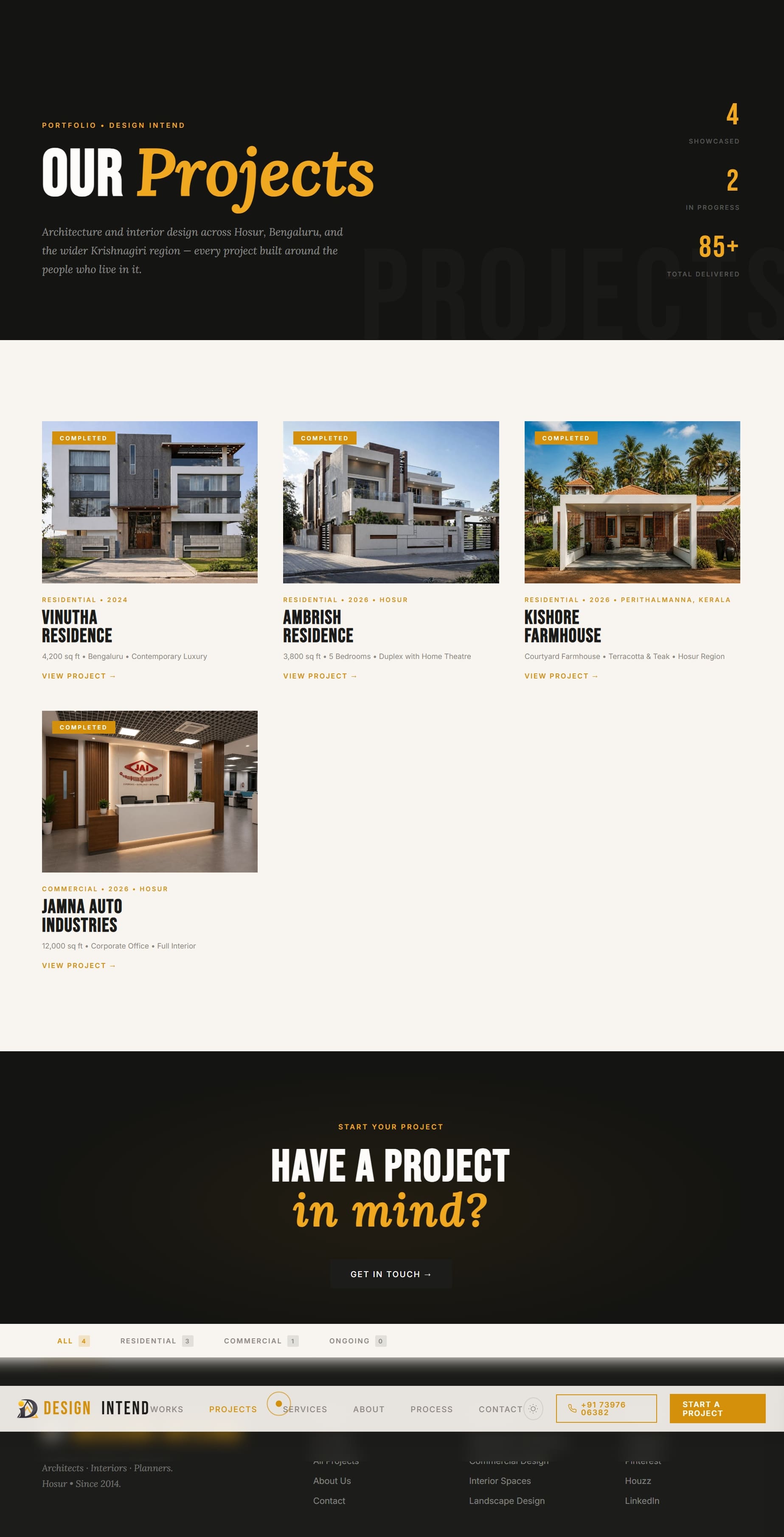
- A real project portfolio — not just images, but actual case study pages for completed projects. The Kishore farmhouse in Perinthalmanna, Kerala. The Jamna Auto Industries facility in Hosur. The Vinutha residence in Bengaluru. Real projects, real details, real photography. This matters enormously because AI-powered search engines and Google alike look for evidence of actual work, not just claims.
- Schema markup throughout — LocalBusiness, ProfessionalService, Article, BreadcrumbList, FAQPage. This is the machine-readable layer that tells search engines and AI engines exactly what kind of business this is, where it operates, and what it offers.
- A construction cost calculator for Hosur — a genuinely useful tool that answers the first question almost every client has: "how much will this cost?" Useful content earns attention; it doesn't beg for it.
- A cornerstone guide on building a home in Hosur — covering everything from plot selection to completion certificates. The kind of resource that a homebuilder bookmarks and refers back to, and that earns citations from AI search engines.
The technical foundation was equally deliberate. Sub-2-second load time. Mobile-first layout — because a significant portion of searches in Hosur come from mobile. Correct canonical URLs, no duplicate content issues, clean redirect structure, a sitemap that Google can follow without confusion.
Google Business Profile
The GBP setup is not glamorous work but it is non-negotiable. A fully completed, verified Google Business Profile is the single highest-return action for a local business in India. It feeds directly into Google Maps results, Google AI Overviews, and local pack rankings.
We set up the profile from scratch, chose the correct primary and secondary categories, wrote a description that uses natural language a client would use, uploaded project photos organised by category, set up the service area correctly, and made sure the business name, address, and phone number matched exactly what appeared on the website. NAP consistency sounds minor; it is not. Inconsistencies across sources lower AI confidence in the business data.
Social channels
Instagram and Facebook were set up with branded profiles. These are not primarily lead generation channels for architecture in Hosur — clients rarely direct-message an architect from Instagram. But they serve a crucial trust function: when a prospective client researches a business they've been referred to, a consistent social presence confirms the business is active and professional. Gaps in that story create doubt.
They also contribute to third-party digital signals that AI engines use to assess business legitimacy. A business with a GBP, a website, and active social profiles reads as far more established than a business with only one of those.
The first four weeks after launch
The site went live and we waited. Not passively — we submitted the sitemap to Google Search Console, used IndexNow to push URLs for rapid indexing, set up Google Analytics and Ahrefs tracking, and began the structured content publishing schedule. But you cannot rush the indexing and trust-building process. The first weeks are about getting the foundation right.
-
1Week 1 — Launch and indexing Site live, GBP published, sitemap submitted. IndexNow submission to Bing and Yandex. Google began crawling within 48 hours of submission.
-
2Week 2 — First rankings appear Location-specific pages started appearing in Google results for lower-competition queries. The Hosur construction cost page began ranking for long-tail calculator queries.
-
3Week 3 — GBP starts showing in Maps Design Intend appeared in Google Maps results for "architect Hosur" and related terms. First two enquiries came in through the website contact form — one for a residential project in Bagalur, one for interior design consultation.
-
4Week 4 — Third enquiry converts A third enquiry came in — an office interior project. This one moved quickly from enquiry to site visit to signed agreement. Project value: ₹20 lakh.
Three qualified leads in four weeks from a brand-new website with no paid advertising, no social media campaigns, and no link-building outreach. Pure organic search.
The lead that became a ₹20 lakh project
The converted project is worth examining closely because it illustrates something important about how digital presence actually works for professional services.
The client found Design Intend by searching for interior designers and architecture firms in Hosur. They were looking for someone to design and execute an office interior — a substantial commercial fitout, not a small consultation. The kind of project that typically goes through multiple rounds of referral asking, portfolio reviews, and trust-building before a decision is made.
By the time they called Ar. Chittrarasan, they had already done that trust-building work themselves. They'd seen the portfolio on the website. They'd read through the project case studies. They'd looked at the Google Business Profile and seen a legitimate, established-looking firm. When the call happened, it wasn't a cold introduction — it was a conversation with someone they had already decided they wanted to work with.
This is the compounding effect of a well-built digital presence. The website did the qualifying and trust work before any human was involved. The first call was already warm.
The website and GBP were set up less than a month ago and we already have a signed project. I was sceptical that this would work so fast, but the client told us they had seen our portfolio online and were already impressed before calling. That kind of introduction doesn't happen with just a referral.
What we learned from this
Every engagement teaches us something. Here is what this one reinforced.
The quality of the work matters more than the quantity of content
We did not publish 50 generic service pages. We published fewer than 40 pages, but each one was built to genuinely answer a question a real client would have. The construction cost calculator, the Hosur homebuilding guide, the project case study pages — these are things with inherent value. They earned trust with search engines because they earned trust with people first.
Local SEO in smaller cities is under-invested
Hosur is not Bengaluru. The search volumes are lower, but so is the competition. A well-structured website with correct GBP information can reach the top of local results for an architecture or interior design firm within weeks, not months. Businesses that move first in these markets build an advantage that compounds as the city grows.
The offline-to-online trust transfer is real
Ar. Chittrarasan had ten years of trust built through completed projects and word of mouth. The website's job was to make that trust visible to people outside that existing network. The project portfolio did exactly that — it showed real, completed work with real locations and real context. Prospective clients could see what he had built and make a genuine judgement. That is far more persuasive than any amount of marketing copy.
Speed of ROI depends on the quality of the foundation
Four weeks is fast. Not all clients see a conversion that quickly — it depends on the specific market, the competition, and the project type. But the reason this came through quickly is that everything was done correctly from the start: the technical structure, the schema markup, the GBP, the NAP consistency, the content depth. There was nothing for Google to be confused about. The foundation was clean, so the results came faster.
Retainer work is about continuous compounding
The ₹35,000 monthly retainer covers ongoing website optimisation, local SEO monitoring, and social media management. The first conversion more than covered the cost of the website. Month two and onwards, the retainer keeps the rankings strengthening, new project pages going live as projects complete, and the social presence active. The asset gets more valuable over time, not less.
Frequently asked questions
Was any paid advertising involved in getting these leads?
No. These were organic search leads — people finding Design Intend through Google search and Google Maps without any paid ads. This makes the lead quality higher (they were actively searching for the service) and the cost per lead lower over time, because the content and authority built continue working long after the initial investment.
How typical is a 4-week result?
Faster than average, but not unusual for well-structured local SEO in a city like Hosur where competition for the specific queries was relatively low. For more competitive markets or broader geographic targets, the timeline to first leads is typically 6 to 12 weeks. The quality of the site structure and GBP setup directly affects speed.
What does the monthly retainer cover?
The ₹35,000/month retainer includes: ongoing monitoring of Google rankings and Search Console, monthly technical audits to catch and fix any issues, new content publishing (project pages, guides, local area pages), Google Business Profile maintenance and post updates, and social media management for Instagram and Facebook (content scheduling, basic engagement). It also includes updating the website as new projects complete — each new project page is an ongoing SEO asset.
Can OptiScale do the same for my business?
The approach is repeatable, but it's not identical for every client. The strategy depends on your specific market, competition, and service type. The first step is a discovery call where we look at your current situation and tell you honestly what the opportunity looks like and how long a realistic timeline is. Book a free 15-minute call here.
What if my industry is different from architecture?
The principles are identical for any service-based business that gets clients through local search: CA firms, doctors, law firms, interior designers, tutors, contractors, real estate agents. The specifics change — the keywords, the content structure, the schema type — but the underlying approach of building genuine authority and making it visible to search engines is universal. We have worked across multiple service categories in India.
You might also find useful: